Cold Espresso Concentrate vs Hot Espresso: The Real Cost Per Shot
Beans, power, maintenance, and waste — what a shot of hot espresso actually costs, and how a 1 litre bottle of concentrate compares once you count everything.
It's the question every café manager, bar buyer, and home enthusiast asks before their first order: how far does a bottle actually go? With NORSE's 8:1 Cold Espresso Concentrate, the answer is more generous than most people expect — and once you run the numbers on cost, it gets genuinely interesting for anyone pouring drinks for a living.
The Short Answer
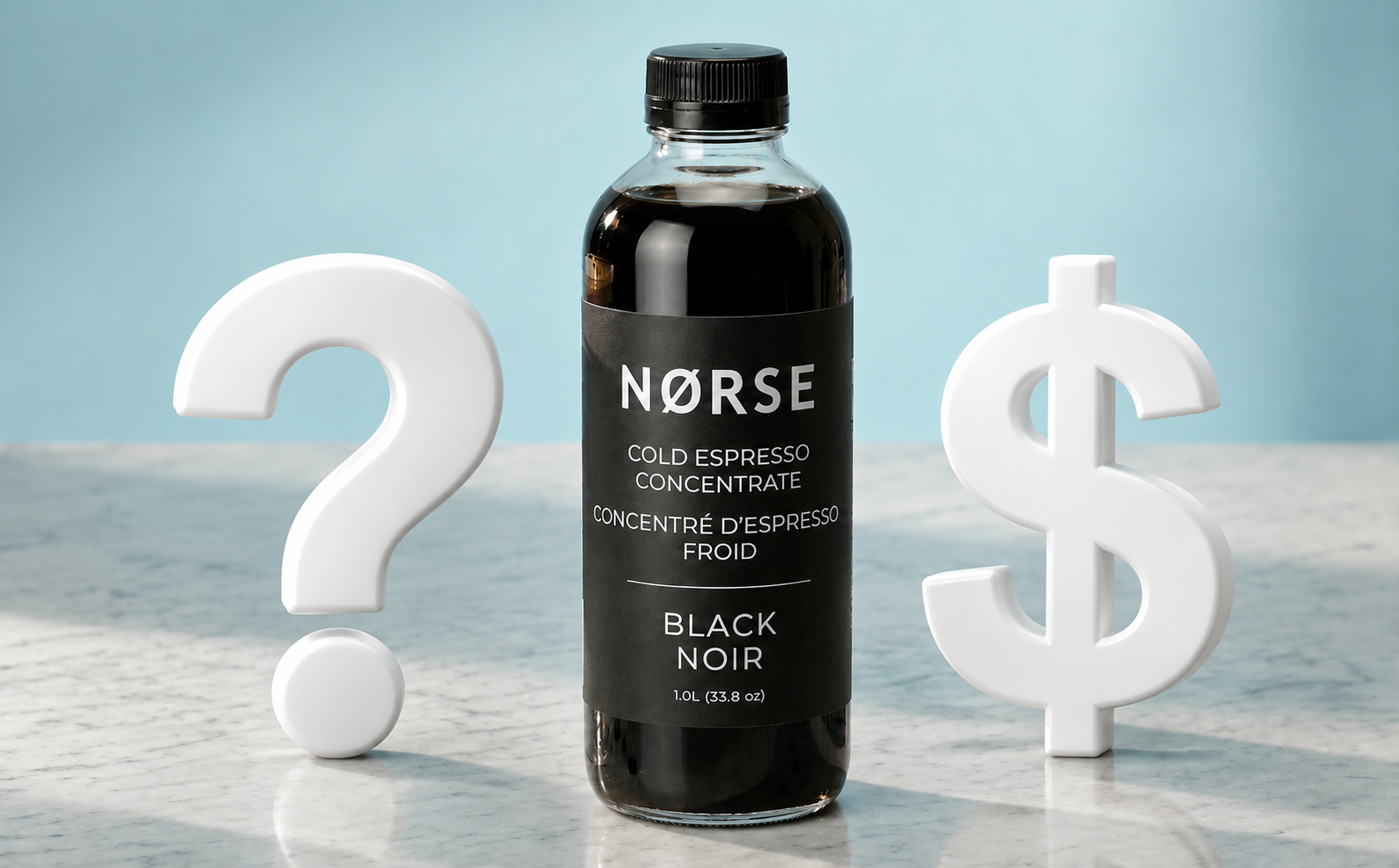
NORSE's Cold Espresso Concentrate is brewed at an 8:1 ratio — one part concentrate to eight parts milk or water. That means a single 1 litre bottle isn't just one litre of cold brew. It's the base for roughly 9 litres of finished drink once diluted, because the concentrate itself becomes part of the total pour.
Broken down into servings, using the 30 mL shot NORSE recommends as a single dose: a 1 litre bottle yields about 33 shots. Each shot, mixed with its 240 mL of milk or water, becomes a 270 mL finished drink — close to a standard 9 oz iced latte. So one bottle comfortably produces 33 full-size cold drinks, or roughly 300 fl oz of finished beverage in total. Scale that however you like: fewer, larger drinks, or more, smaller ones — the 8:1 ratio holds either way.
That yield is also why the concentrate format exists in the first place. NORSE brews every batch cold for up to 24 hours, then concentrates it so a bar or café doesn't need brewing equipment, dial-in time, or a barista babysitting an espresso machine to get a consistent shot. You pour, you dilute, you serve — the same 180 mg-caffeine, 30 mL shot every time, with a 12-month shelf-stable bottle sitting behind the bar instead of a fridge full of yesterday's batch.
The Economics
Here's where it gets useful for anyone running a menu rather than a home kitchen. Say a bar or café is paying roughly $3 per 100 mL for the concentrate — that works out to $30 per litre, or $0.90 per 30 mL shot. (Actual wholesale pricing depends on format and volume — NORSE also ships Bag-in-Box and 4L caddies for higher-volume accounts, which typically improve on a retail bottle's per-litre cost. The numbers below use $3/100 mL as an illustrative baseline.)
At that cost basis, a single 1 litre bottle represents about $30 of ingredient cost and, at 33 shots per bottle, roughly $0.90 of concentrate in every drink it touches — whether that drink is a $5.50 iced latte or a $16 espresso martini. The concentrate cost barely moves. What moves is the price the finished drink commands, and that's where the two applications diverge sharply.
Cold Lattes
A 270 mL iced latte built from one 30 mL shot and 240 mL of milk carries a concentrate cost of $0.90 and, at a typical wholesale milk price around $2.20/L, roughly $0.53 of milk — about $1.43 in total ingredient cost. Priced at $5.50, that's a gross margin of roughly $4.07, or about 74%, with the concentrate itself sitting at around 16% of the menu price. That's a strong, entirely normal pour cost for a café beverage, and it's the bread-and-butter case NORSE is built for: consistent, fast, and priced in line with any other cold coffee drink on the menu. Across a full bottle, that's about $182 of potential latte revenue from $30 of concentrate.
Espresso Martinis
The more interesting math shows up on the bar side. An espresso martini typically uses about the same 30 mL (1 oz) of espresso or cold brew concentrate, paired with 1.5 oz vodka and 0.5 oz coffee liqueur, plus a touch of syrup and a garnish. Using typical well-spirit and liqueur costs, that's roughly $2.70 in total ingredient cost per cocktail — and the concentrate is still only $0.90 of it. But espresso martinis routinely sell for $14–18 in bars and restaurants. At $16, that's a gross margin of about $13.30, or roughly 83%, with the concentrate representing only about 5.6% of the menu price — a third of what it represents on a latte.
Run that across the same bottle: 33 espresso martinis at $16 is about $528 in potential revenue from the same $30 of concentrate — nearly 3x the revenue of the latte scenario, and over 17x the cost of the bottle itself. And that's before counting what a cocktail program adds beyond the receipt: espresso martinis and cold brew tonics are menu draws in their own right, they move at hours when a coffee bar would otherwise be quiet, and using a shelf-stable concentrate means the bar can build a consistent one every time without keeping fresh espresso on hand or training staff on pulling shots.
| Cold Latte | Espresso Martini | |
|---|---|---|
| Serving size | 270 mL (1 shot + milk) | 1 oz concentrate + spirits |
| Concentrate cost | $0.90 | $0.90 |
| Other ingredients | ~$0.53 (milk) | ~$1.80 (vodka, liqueur, syrup, garnish) |
| Typical menu price | $5.50 | $16.00 |
| Gross margin | ~74% | ~83% |
| Concentrate as % of price | ~16% | ~5.6% |
| Revenue per 1 L bottle (33 servings) | ~$182 | ~$528 |
The Real Cost Per Shot
Everything above prices the concentrate. To compare it honestly against hot espresso, the espresso has to be priced the same way — beans included, not just the overheads that usually get left out.
Start with the coffee itself. At $70 for 2 kg of beans, an 18 g espresso dose costs about $0.63 before anything is switched on. Then add what it takes to actually pull the shot, because that means running a machine and a grinder rather than measuring a pour:
| Cost per shot of hot espresso | Typical range |
|---|---|
| Beans (18 g at $35/kg) | $0.63 |
| Electricity | $0.03–$0.08 |
| Water + filtration | $0.01–$0.03 |
| Cleaning chemicals | $0.01–$0.03 |
| Machine/grinder maintenance | $0.05–$0.15 |
| Grinder purge/waste | $0.04–$0.08 |
| Total per shot | $0.77–$1.00 |
That is the number to hold against the concentrate's $0.90 per 30 mL shot — and it lands squarely inside the range. On cost per shot, a NORSE pour and a pulled espresso are, near enough, the same drink economically. And the $0.77–$1.00 figure is still before labour: it counts no barista time to dose, tamp, pull, purge, and wipe down.
That changes what the concentrate is actually selling. It is not a cheaper shot. It is the same shot cost without the machine, the grinder, the plumbed water line, the daily cleaning cycle, the service contract, or the training — no equipment to buy or finance, no purged grounds at the start of every shot, and no variance between a practised barista and whoever is covering the morning.
Applied to the cold latte from earlier, the two paths land within pennies of each other. A concentrate-built latte carries $1.43 in ingredients, for a 74% margin at $5.50. The same latte pulled from hot espresso carries $0.63 in beans, $0.53 in milk, and $0.14–$0.37 in machine overhead — $1.30 to $1.53 all in, or a margin somewhere between roughly 72% and 76%. The margin is a wash. What is not a wash is everything that has to sit behind the counter to produce it.
There is a taste argument that comes along with it, too. Hot extraction pulls more bitterness and acidity out of the grounds; NORSE's cold-steeped process — up to 24 hours, no heat — is what makes the concentrate smoother and less acidic in the first place. So the switch that removes the machine, the maintenance, and the waste is also the one that gets the better cup. The simplification and the quality improvement come from the same decision, not opposite trade-offs.
The Takeaway
One litre of NORSE's 8:1 Cold Espresso Concentrate goes further than the label suggests — about 9 litres, or 33 full servings, of finished beverage, at roughly $0.90 a shot. Priced against hot espresso done properly, beans and machine overhead included, that sits inside the same $0.77–$1.00 band. The case for concentrate was never that it undercuts espresso on cost per shot; it is that it matches it while removing the machine, the grinder, the maintenance, the training, and the labour behind every cup. For a bar, the same bottle is a high-consistency shortcut into one of the highest-margin categories on the menu: the concentrate cost barely changes between a latte and a cocktail, but what you can charge for the cocktail does — and that gap, plus the equipment you never have to buy, is exactly why more cafés and bars are building their cold coffee and coffee-cocktail programs around a concentrate rather than an espresso machine.
Cost figures above are illustrative, based on a $3/100 mL concentrate price and typical North American ingredient and menu pricing. Actual costs and margins vary by market, format, and account volume — get in touch about commercial pricing for exact numbers on your program.
NORSE Cold Brew
Can’t find what you’re looking for?