Why Water Is the Most Overlooked Ingredient in Your Coffee
Coffee is 90–99% water — yet water is almost never what people talk about. The minerals in your tap are quietly shaping every cup you serve.
Coffee is mostly water. A shot of espresso, a glass of cold brew — strip away the romance of the bean and what you're actually drinking is somewhere between 90% and 99% water. Yet water is almost never the thing people talk about when they describe a "good" coffee. They talk about the roast, the origin, the barista's technique. Water just sits there in the background, doing more work than anything else in the cup.
That's a mistake, because water isn't neutral. It carries minerals — calcium, magnesium, bicarbonates — that interact directly with coffee compounds during extraction. Too little mineral content and the coffee tastes flat and underextracted, no matter how good the beans are. Too much, or the wrong balance, and you get harsh, chalky, or bitter notes that have nothing to do with the roast. Chlorine, chloramine, sediment, and other municipal water quirks can mute aroma entirely. The same beans, pulled with the same machine, by the same barista, can taste like two different coffees depending solely on what's coming out of the tap.
Hot Coffee: Where Water Chemistry Meets the Clock
In espresso, water is under pressure and heat for a matter of seconds. That narrow window means extraction is incredibly sensitive to water chemistry — the minerals in the water need to be balanced enough to pull the right oils and acids out of the grounds without scaling up the machine or stripping the shot of body.
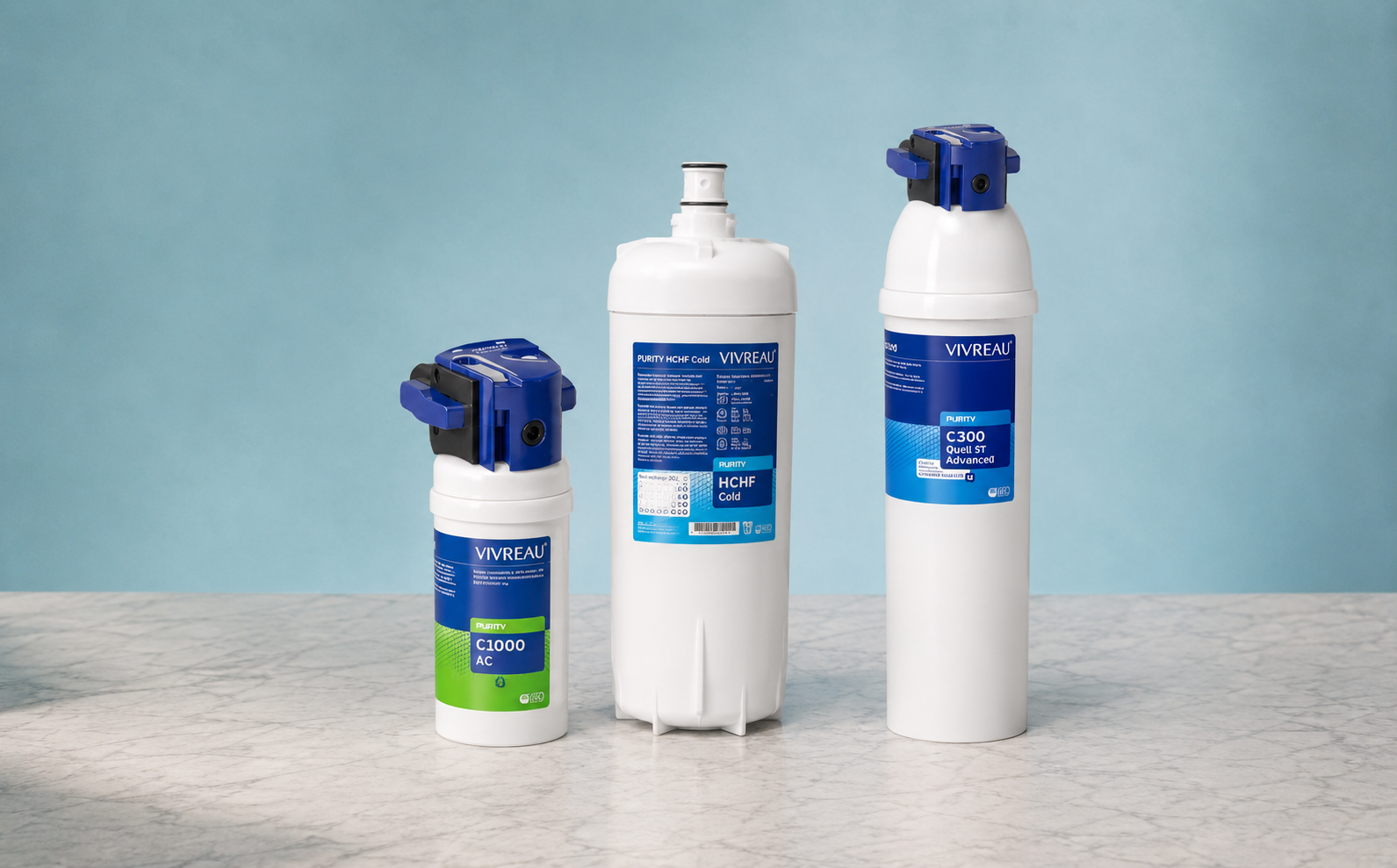
This is exactly why so many cafés invest in dedicated water filtration. Companies like Vivreau build systems specifically so that every shot pulled at a location tastes the same — this morning, next week, at the downtown branch, and at the airport kiosk. Their commercial filtration lines are designed to strip out chlorine, chloramine, and excess minerals while retaining the ones that actually support flavor, so the water feeds machines consistently and protects them from limescale at the same time. The real win for a café isn't just better-tasting coffee on day one — it's that a returning customer gets the same coffee every single time they order one. That consistency is what turns a one-off good experience into brand loyalty.
Cold Brew: A Different Kind of Water Problem
Cold brew flips the entire equation, and that's what makes it so much harder to get right at scale.
There's no heat to drive a fast extraction, and no pressure to force it. Instead, grounds steep in cold or room-temperature water for 12 to 24 hours, relying on time and immersion to slowly pull flavor out of the coffee. That long, slow contact means water is doing even more of the work than it does in a hot brew — and it means any inconsistency in that water doesn't get masked by heat or speed. It just sits there, fully exposed, for an entire day.
Scale makes the problem bigger, not smaller. A café might filter a few liters of water a day for espresso. A cold brew producer is steeping in batches measured in hundreds or thousands of liters, and every one of those batches needs to hit the same mineral balance, the same purity, the same pH — batch after batch, week after week — or the product drifts. A shift in water chemistry that would be invisible in a 25-second espresso pull becomes very obvious after a full day of cold extraction, where subtle off-notes have nowhere to hide and nothing to burn off.
How We Think About Water at Norse
This is the problem we built our process around. Norse Kaffé is a no-heat, cold-craft brand from the ground up — which means we don't get the shortcuts that heat and pressure give traditional coffee. Every batch lives or dies on the quality and consistency of the water it's steeped in.
Holding that chemistry and purity steady isn't a one-time fix; it's a discipline we apply across every batch, every format, and every market we ship to — whether that's a 250ml can or a 4L line feeding a nitro tap. The goal is the same one Vivreau solves for in cafés, just stretched across a much longer extraction and a much larger volume: when someone reaches for a Norse Nitro Cold Brew, it should taste exactly like the last one they had. Water is the ingredient nobody sees, and getting it right, consistently, at scale, is a big part of what separates a great cold brew from an average one.
NORSE Cold Brew
Can’t find what you’re looking for?